 40+ Yrs Experience
Dr. K. Amarnath
M.B.B.S., D.C.H.
Consultant & Director
Typically replies instantly
Expert diagnosis and compassionate treatment for muscular dystrophy, SMA, peripheral neuropathy and other nerve-and-muscle conditions, backed by EMG and nerve-conduction diagnostics.

Muscle weakness in children can come from many places — the muscle itself, the nerve supplying it, or the junction between the two. A toddler who falls often, a child who tires quickly on stairs, or one who is slower to reach movement milestones can all be pointing to different underlying conditions.
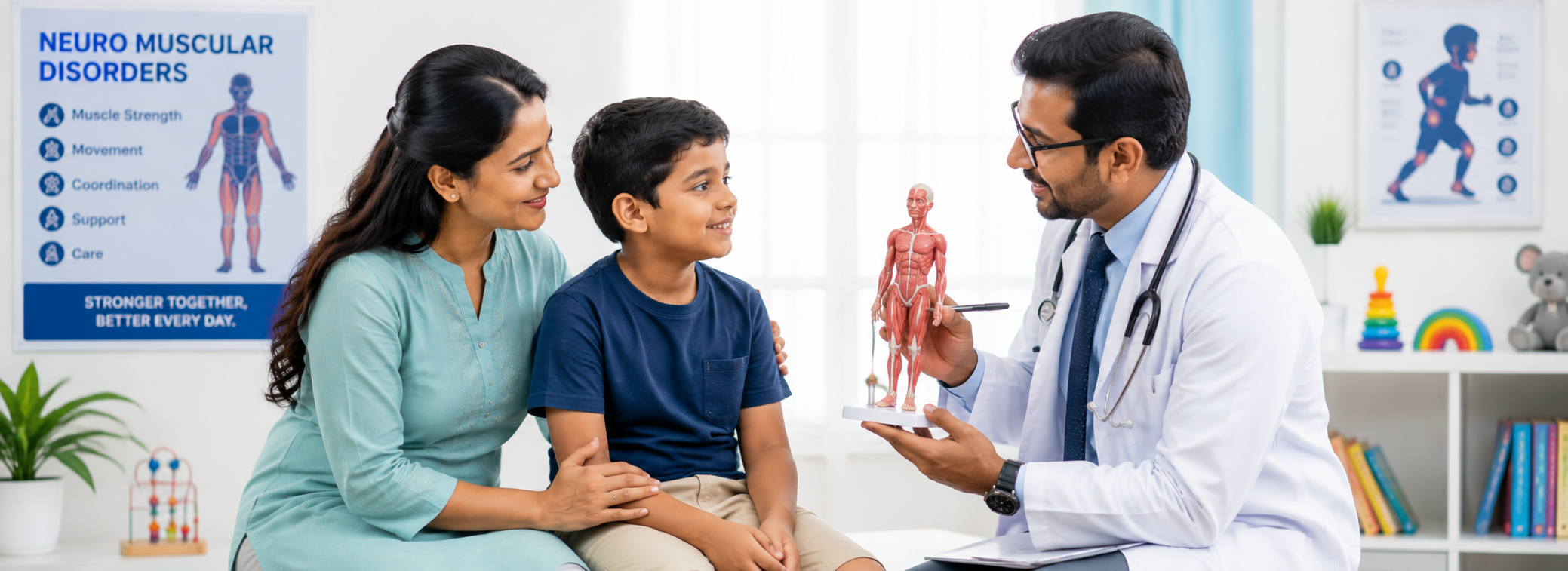
Our team begins with a careful strength and movement assessment, backed by EMG, nerve-conduction studies and genetic testing where needed, to pinpoint the exact cause before recommending a plan — then tracks that plan closely as your child grows.
Muscle Weakness Is Our Starting Point, Not Our Only Focus
Muscle weakness in children can trace back to the muscle, the nerve, or the connection between them. Our team evaluates each possibility with the same diagnostic rigor, from a single delayed milestone to a sudden loss of strength.
Select a Condition
A clear, child-focused approach to understanding nerve-and-muscle concerns and planning the right care.
We understand your child's strength, movement history, milestones and family history through a focused neuromuscular evaluation.
A careful review of strength, movement history, milestones, and family history helps guide the next stage of evaluation.
When required, EMG, nerve-conduction studies and genetic testing help our specialists better understand your child's condition.
EMG, nerve-conduction studies and other relevant investigations may be advised when clinically required to better understand the condition.
Based on the diagnosis and individual needs, a personalized treatment and therapy plan is developed to support strength and mobility.
Treatment is planned according to the diagnosis, symptoms, and individual neuromuscular needs of the child.
Regular follow-up visits help track strength and mobility, review treatment response, and adjust the care plan as your child grows.
Regular reviews help monitor strength and mobility, understand treatment response, and make changes to the care plan when required.
Meet our team of experienced pediatricians committed to providing attentive, compassionate, and comprehensive care for children at every stage of growth.
40+ Yrs Experience
M.B.B.S., D.C.H.
Consultant & Director
 25+ Yrs Experience
M.B.B.S., D.C.H., F.I.A.P., P.G.P.N. (Boston)
Consultant & Director
 30+ Yrs Experience
M.B.B.S., D.C.H.
Consultant & Director
 27+ Yrs Experience
M.B.B.S., D.C.H., D.N.B.
Consultant & Director
 25+ Yrs Experience
M.B.B.S., D.C.H. (Ped)
Consultant & Director
 25+ Yrs Experience
M.D. (Ped)
Consultant & Director
Leave your details and our care team will contact you to guide you with the next step.
Simple answers to common questions about childhood neuromuscular conditions and care.
Neuromuscular disorders affect the nerves that control muscles or the muscles themselves, and can cause weakness, fatigue, or delayed motor milestones. Symptoms and severity vary widely between children.
No. Some, like muscular dystrophy and SMA, are genetic, while others, like Guillain-Barre syndrome, can develop suddenly after an infection. A detailed evaluation helps identify the underlying cause.
Consider an evaluation for delayed walking, frequent falls, muscle weakness, difficulty climbing stairs, rapidly progressing weakness, or unexplained fatigue.
EMG and nerve conduction studies, along with blood tests and genetic testing where indicated, help evaluate how nerves and muscles are functioning.
Treatment depends on the specific condition and its cause. Some conditions are managed with therapy and supportive care, while others need targeted medical treatment planned by the specialist.
Regular follow-ups help track strength and mobility over time, monitor treatment response, and adjust the care plan as your child grows.