 40+ Yrs Experience
Dr. K. Amarnath
M.B.B.S., D.C.H.
Consultant & Director

Typically replies instantly
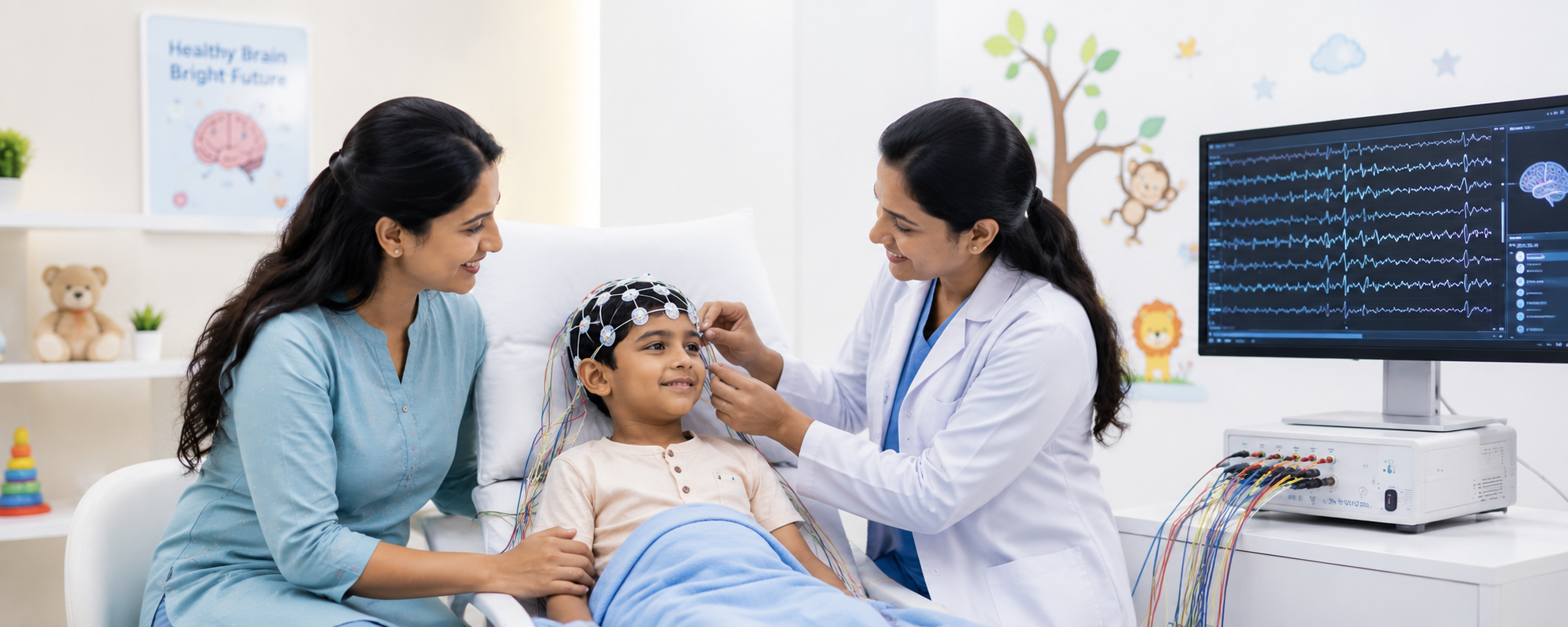
A painless, non-invasive EEG test that records your child's brain waves — helping our pediatric neurology team detect seizures, unexplained episodes and abnormal brain activity with accuracy and clarity.

An EEG (electroencephalogram) is a test that records the electrical activity of the brain using small, flat sensors called electrodes, gently placed on the scalp. These electrodes pick up the natural electrical signals produced by brain cells as they communicate with one another, and display them as wave patterns on a screen.
In children, an EEG is one of the most important tools for understanding what's happening during seizures, unexplained staring spells, sudden jerking movements, or unusual behavioural episodes. It helps our pediatric neurology team see whether the brain's electrical activity is following a normal pattern or showing signs that need further attention — with results explained to you in plain language, not just a printed report.
The Right Test, Matched to Your Child's Symptoms
Not every child needs the same kind of EEG. Depending on when episodes happen and what a routine test shows, we may recommend a sleep-deprived, overnight, or video EEG for a clearer picture.
Select an EEG Type
A structured, child-friendly approach to EEG testing — from the first consultation, through the recording itself, to a diagnosis and clear next steps.
We review your child's symptoms and episode history to decide which type of EEG is right. Hair should be clean and free of oils, gels or braids so electrodes attach properly.
For sleep-deprived studies, we'll guide you on exactly how to reduce your child's sleep the night before, so the recording captures the clearest possible reading.
Small electrodes are attached to the scalp using a soft, washable paste. There are no needles and no discomfort — just gentle sensors resting on the surface of the skin.
Our technicians are trained to keep children calm and comfortable throughout, using distraction techniques so setup feels quick and unremarkable.
Your child rests, relaxes or sleeps while brain activity is recorded. They may be asked to breathe deeply or briefly look at a flashing light, as some patterns only appear under these conditions.
Recording length depends on the test type — 20 to 40 minutes for a routine EEG, longer for sleep or video studies — to ensure a clean, artefact-free reading.
A pediatric neurologist interprets the EEG trace alongside your child's clinical history and explains the findings to you in plain language, with clear next steps.
EEG findings are always correlated with symptoms and history, so results are never over- or under-interpreted. Routine EEGs are typically reported within 24–48 hours.
Meet our team of experienced pediatricians and pediatric neurology specialists committed to providing attentive, compassionate and accurate EEG-based diagnostic care for children at every stage of growth.
40+ Yrs Experience
M.B.B.S., D.C.H.
Consultant & Director
 25+ Yrs Experience
M.B.B.S., D.C.H., F.I.A.P., P.G.P.N. (Boston)
Consultant & Director
 30+ Yrs Experience
M.B.B.S., D.C.H.
Consultant & Director
 27+ Yrs Experience
M.B.B.S., D.C.H., D.N.B.
Consultant & Director
 25+ Yrs Experience
M.B.B.S., D.C.H. (Ped)
Consultant & Director
 25+ Yrs Experience
M.D. (Ped)
Consultant & Director
Leave your details and our pediatric neurology team will contact you to guide you on the right EEG test for your child.
Simple answers to the most common questions about pediatric EEG (electroencephalography) testing.
An EEG (electroencephalogram) records the brain's electrical activity through small sensors placed on the scalp. In children it is used to investigate seizures, unexplained episodes, and unusual behavioural or developmental patterns.
No. An EEG is completely painless and non-invasive. The electrodes only rest on the scalp's surface and don't cause any discomfort, and our team uses a calm, child-friendly approach throughout the test.
Not entirely. Some children with epilepsy have a normal EEG between seizures, since the test only captures activity during the recording window. If seizures are strongly suspected, a sleep-deprived or sleep EEG may be recommended to improve detection.
Wash and dry your child's hair the night before with no oils, gels or styling products, and avoid braids so electrodes can attach properly. For sleep-deprived studies, our team will advise on limiting sleep beforehand.
No, EEG cannot diagnose autism. It is used alongside a full neurological evaluation to check for co-existing seizure activity, which is more common in children with autism spectrum disorder.
A routine EEG usually takes 20 to 40 minutes, while sleep or overnight EEGs take longer to capture a full sleep cycle. Routine EEGs are typically reviewed and reported within 24 to 48 hours.